

The MONA Exploit: An In-Depth Analysis
Trinh Diem Quynh
On April 14, 2026, the decentralized finance ecosystem witnessed a highly sophisticated economic exploit targeting the MONA token on the BNB Smart Chain. Occurring at block 92,429,268, this security breach allowed an attacker to drain substantial assets by manipulating a flawed, delayed token-burning mechanism. Rather than a standard arbitrage trade or routine user activity, this event represents a calculated attack on the protocol's fundamental economic logic. Specifically, the attacker did not rely on common smart contract vulnerabilities like reentrancy or integer overflows, but instead exploited the underlying accounting rules to distort the automated market maker liquidity pool.
The Core Defect: How Delayed Action Compromised MONA Token Security
To understand the root cause of the vulnerability, one must analyze the original design intentions behind the MONA token transaction fees. The protocol implemented a sell tax meant to permanently remove tokens from circulation, thereby reducing total supply and theoretically boosting asset value. However, instead of executing this burn instantly during a sale, the smart contract stored the pending burn volume in a temporary accumulator variable, deferring the actual destruction until an external transaction triggered the update.
Consequently, this decoupling of the burn obligation from its actual execution created a highly dangerous window of opportunity. During this brief operational gap, the state of the liquidity pool could be heavily distorted because the asset environment changed entirely before the protocol finalized the burn. Ultimately, this structural delay allowed the attacker to invalidate the protocol's core assumption that the tokens earmarked for destruction would still exist in their original proportions.
Breaking Down the Structural Flaws in the Architecture
The collapse of the MONA framework stemmed directly from three critical architectural flaws that granted the attacker total control over the pool's state.
First, the protocol introduced an immediate payout with deferred consequences within the transaction logic. When a user sold their assets, the system granted them the full output currency immediately, yet failed to deduct the corresponding MONA tokens from the pool in real time. Because the contract simply updated a ledger rather than executing the burn, it generated an artificial debt that allowed the attacker to manufacture a massive pending burn credit.
Second, the system permitted an unverified public trigger that allowed any network participant to force a contract update. The attacker discovered that executing a standard token transfer with an amount of zero still forced the contract to process its internal update function. Since this zero-amount transfer required neither a token balance nor an approval allowance, the attacker gained a cost-free, permanently available mechanism to trigger the delayed burn whenever conditions were optimal.
Third, the final and most destructive flaw lay in how the burn function interacted with the automated market maker pool. Instead of destroying tokens from a neutral treasury, the contract subtracted the assets directly from the active liquidity pair address and immediately ran a synchronization command. This direct manipulation overrode the invariant rules of the automated market maker, which dictate that reserves must only change via standard swaps or liquidity provisions, completely breaking the protocol's pricing model.
A Step-by-Step Chronology of the MONA Exploitation Flow
To turn these architectural flaws into a profitable venture, the attacker orchestrated a multi-stage operational sequence executed entirely within a single transaction block.
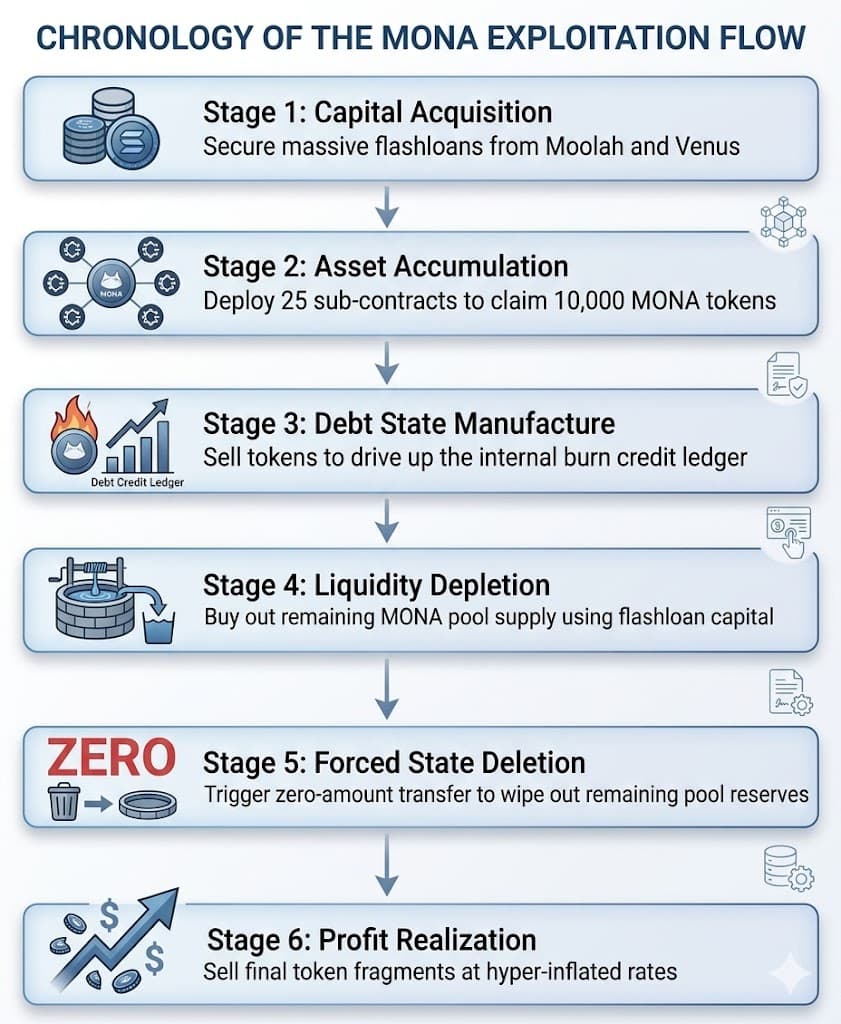
Initially, the attacker acquired significant capital through flashloans from prominent lending protocols and immediately deployed twenty-five auxiliary contracts to accumulate an initial stash of ten thousand MONA tokens. Following this setup, the attacker sold the majority of these tokens back into the pool, which purposefully inflated the pending burn ledger while leaving the actual pool balance untouched.
Once this economic trap was set, the attacker used the massive flashloaned capital to purchase nearly all remaining MONA tokens out of the liquidity pool, driving the pool's internal asset reserve down to a bare minimum. At this exact moment of maximum vulnerability, the attacker executed the zero-value transfer to trigger the deferred burn function. Because the liquidity pool had already been hollowed out, this forced burn wiped out the remaining fragments of the token, creating an extreme mathematical imbalance that sent the asset price skyrocketing. To conclude the exploit, the attacker sold their final hundred tokens back into the starved pool, extracted the remaining capital, repaid the initial flashloans, and walked away with the net profits.
Governance Warnings and Centralization Risks Exposed
Beyond the purely technical vulnerabilities, the incident uncovered alarming transparency issues regarding the project's governance structure. On-chain data tracking revealed that the millions of MONA tokens bought out of the liquidity pool during the fourth stage of the attack were transferred directly to the protocol's official deployer address.
This explicit overlap between the privileged administrative wallet and the beneficiary of the asset drain serves as a massive red flag for market participants. While blockchain data alone cannot definitively prove whether this was a malicious insider rug-pull or an external exploitation of a developer's wallet, it heavily damages community trust and highlights the profound risks of centralized control within supposedly decentralized projects.
Crucial Security Lessons for Blockchain Developers and Smart Contract Auditors
The successful manipulation of the MONA protocol offers invaluable insights for the broader Web3 development and auditing community, proving that code can function exactly as written and still cause systemic failure.
For smart contract engineers, the primary takeaway is that developers must never defer state-changing operations if the surrounding market environment can be altered before execution occurs. Furthermore, architectural designs should strictly prohibit token contracts from manually mutating liquidity pool reserves outside of standard, time-tested swap and liquidity routines, as manual sync triggers often validate broken states.
For protocol auditors, this exploit serves as a stern reminder that catastrophic losses rarely stem from low-level coding blunders alone, but frequently emerge from flawed business logic assumptions. When auditing complex decentralized systems, professionals must treat any combination of deferred executions, unpermissioned public triggers, and direct liquidity pool access as a maximum-risk zone that requires immediate mitigation.