
·Blog
Aave V4 and the Strategic Evolution of On-Chain Credit
Minh Phương, Nguyễn Anh Tuấn
The proposed upgrade to Aave V4, coupled with the ambitious Aave Horizon initiative, signals a historic transformation for the protocol. It marks the transition from a decentralized lending platform into a primary credit infrastructure for TradFi and RWA.
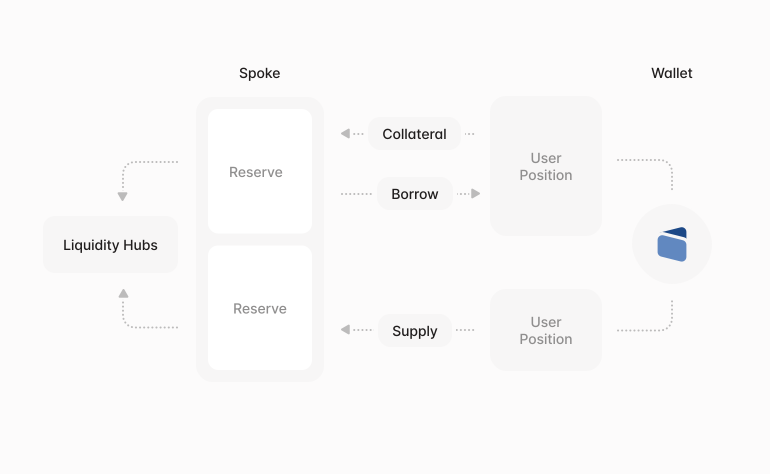
By introducing a revolutionary Hub & Spoke architecture, Aave V4 enables the seamless sharing of massive liquidity pools while maintaining absolute risk isolation through permissioned environments. This strategic alignment between DeFi liquidity and traditional financial standards is poised to unlock billions of dollars in real-world assets, fundamentally reshaping the global on-chain credit market.
Breaking the "Invisible Ceiling" of Crypto Lending
For years, DeFi lending protocols have demonstrated remarkable resilience, surviving numerous market cycles and systemic shocks. Nevertheless, the industry has encountered an invisible ceiling by primarily circulating within the ecosystem of native digital assets like ETH and WBTC. In parallel, the momentum behind RWA (Real World Assets) is accelerating. As of May 2026, the value of on-chain real-world assets has reached approximately $31.41 billion. While institutional capital from TradFi is eager to capture these efficiencies, barriers such as KYC/AML compliance and strict custody requirements have historically hindered participation.From Individual Pools to the Hub & Spoke Model
Although previous iterations of the protocol could host RWA markets, the implementation often resulted in fragmented liquidity. Under the old framework, creating separate markets meant each had to bootstrap capital from scratch. Aave V4 addresses these structural bottlenecks by replacing the traditional pool model with a centralized Liquidity Hub. Within this new paradigm, the protocol functions like a "central bank" where liquidity is consolidated. Specialized "Spokes" then act as branches with independent risk rules. This allows Aave V4 to maintain deep, unified liquidity while providing tailored environments for highly regulated institutional products.Dedicated Solutions for Institutional Custody

The Hub & Spoke design allows Aave V4 to act as a sophisticated financial backend. Users interact through specialized Spokes rather than directly with the core vault. When a Spoke requires capital, it draws from the Hub via a pre-approved credit line.
Specifically, two types of Spokes facilitate institutional entry. RWA Spokes are engineered to handle tokenized securities with built-in access controls. Meanwhile, Vault Spokes allow TradFi funds to pledge assets held in secure multi-signature wallets. This ensures their collateral is never commingled with the broader Liquidity Hub, satisfying strict institutional custody standards.
Aave Horizon: The Gateway for Institutional Capital
Aave Labs has also introduced Aave Horizon, a dedicated permissioned instance designed specifically to attract institutional users. Horizon utilizes RWA tokens, such as treasury fund certificates, as native collateral. This design eliminates the need for complex "wrapping" processes that often introduce additional smart contract risks. Furthermore, when an institution deposits assets, Horizon issues non-transferable receipt tokens (aTokens). This approach ensures absolute compliance with the transfer restrictions typically imposed by traditional asset issuers.Protecting TradFi Assets with Soft Liquidations
Traditional financial institutions are notoriously wary of the "flash-crash" liquidations common in DeFi. To mitigate this, Aave V4 integrates the GHO stablecoin to facilitate "Soft Liquidations" via the Lending-Liquidating AMM (LLAMM). When a position approaches a risk threshold, the protocol automatically generates GHO to cover the debt. It then sells only a minute fraction of collateral to restore a safe standing. Consequently, this mechanism prevents the total loss of a position and reduces selling pressure on less liquid RWA holdings.
Personalized Risk Premiums and the Health Factor
Aave V4 departs from uniform interest rate models by introducing personalized Risk Premiums. Borrowing rates now correlate directly with the quality of the underlying collateral. For instance, a bank utilizing Treasury-backed RWA will enjoy lower rates compared to a user leveraging volatile assets. To track safety, the protocol utilizes the "Health Factor" metric. This index combines collateral value, borrow limits, and liquidation thresholds into a single measure. Furthermore, the new "Target Health Factor" mechanism aims to restore positions to a safe zone rather than applying rigid, fixed penalties. This makes the liquidation process more flexible and less punitive for the borrower.
Achieving Liquidity Without Fragmentation
A central challenge for lending protocols is supporting new assets without spreading risk across the entire system. Aave V4 solves this at the architectural level. By moving risk logic to the Spokes while keeping capital in the Hub, Aave achieves "risk isolation without liquidity fragmentation." This design is particularly vital for RWA. Traditional assets cannot simply be "dropped into a pool" like crypto-native tokens; they require specific pricing and compliance rules. Aave V4 creates specialized environments for these assets without forcing them to build liquidity from zero.Yield Convergence and Structural Impact
The shift toward the Hub & Spoke model facilitates a unique "Yield Convergence." TradFi institutions can move RWA on-chain to borrow stablecoins, while DeFi users provide liquidity to earn yields rooted in real-world economic demand. Ultimately, this moves the protocol away from "inner-circle" crypto leverage. Instead, Aave V4 is evolving into a comprehensive market infrastructure where yield is generated by actual financial needs. This positions Aave as a foundational layer for any on-chain credit market.Identifying the Strategic Trade-offs
Despite its strengths, the Aave V4 model introduces new sensitivities. The consolidation of liquidity makes the Hub a critical point of failure. Any error in its operational logic could have systemic repercussions across all connected Spokes. Consequently, Aave V4 requires the highest standards of mathematical verification and continuous monitoring. Additionally, setting "Risk Premiums" involves a delicate balance; fees must be high enough to price risk accurately but low enough to remain competitive for borrowers.The Road Ahead: What to Watch
To gauge the success of Aave’s transition, several key indicators deserve attention in the coming months. First, the Total Value Locked (TVL) in Aave Horizon will serve as a direct measure of TradFi demand. Second, the adoption rate of Vault Spokes will prove whether the "isolated assets, shared liquidity" model is viable at scale. Finally, the role of GHO within these RWA markets will indicate if Aave can successfully build an on-chain credit layer tied to real-world productivity. If successful, Aave V4 will define the next era of global finance.Authors: Minh Phương, Nguyễn Anh Tuấn - Security Researcher of A-Star Group Compiled by Dieu Anh