·Blog
RISC Zero: Redefining How Blockchain Verifies Truth
Quy Anh
The Problem Smart Contracts Can't Solve
For years, blockchain has been celebrated as a trustless execution environment - transparent, immutable, and censorship-resistant. Consequently, that reputation came with a steep cost: severely limited computational performance. Today's smart contracts simply cannot handle complex workloads like AI inference, machine learning models, or large-scale computation pipelines. High gas costs make execution prohibitively expensive. Specifically, any logic beyond basic financial operations quickly becomes economically unfeasible. A common workaround is moving computation off-chain. However, this breaks blockchain's most fundamental property: trustlessness. When you run code off-chain, you are forced to trust whoever executes it. Oracles, in this context, are merely a way of "wrapping that trust" in a slightly more palatable package. RISC Zero was built to resolve exactly this paradox.The Core Idea: Compute Off-Chain, Trust On-Chain
RISC Zero introduces a deceptively simple but architecturally powerful model: Execute computation off-chain, then verify the result on-chain using a zero-knowledge proof. This fundamentally redefines the role of blockchain. Rather than running code directly, the chain only needs to confirm that a result is correct. Verifying a ZK proof is orders of magnitude lighter than re-executing the full logic. In essence, blockchain evolves from an execution engine into a verification layer - a shift that aligns naturally with the modular blockchain thesis reshaping Web3 infrastructure today.zkVM: A Provable General-Purpose Computer
At the core of RISC Zero is the zkVM - a zero-knowledge virtual machine designed to prove any computation, not just blockchain-specific logic. In contrast to zkEVM, which is constrained to reproducing the Ethereum execution environment, RISC Zero's zkVM operates over a general instruction set (RISC-V) and supports industry-standard languages like Rust and C++. This distinction is critical:- zkEVM is limited to smart contract logic
- zkVM can execute virtually any program
How It Works: From Code to Cryptographic Proof
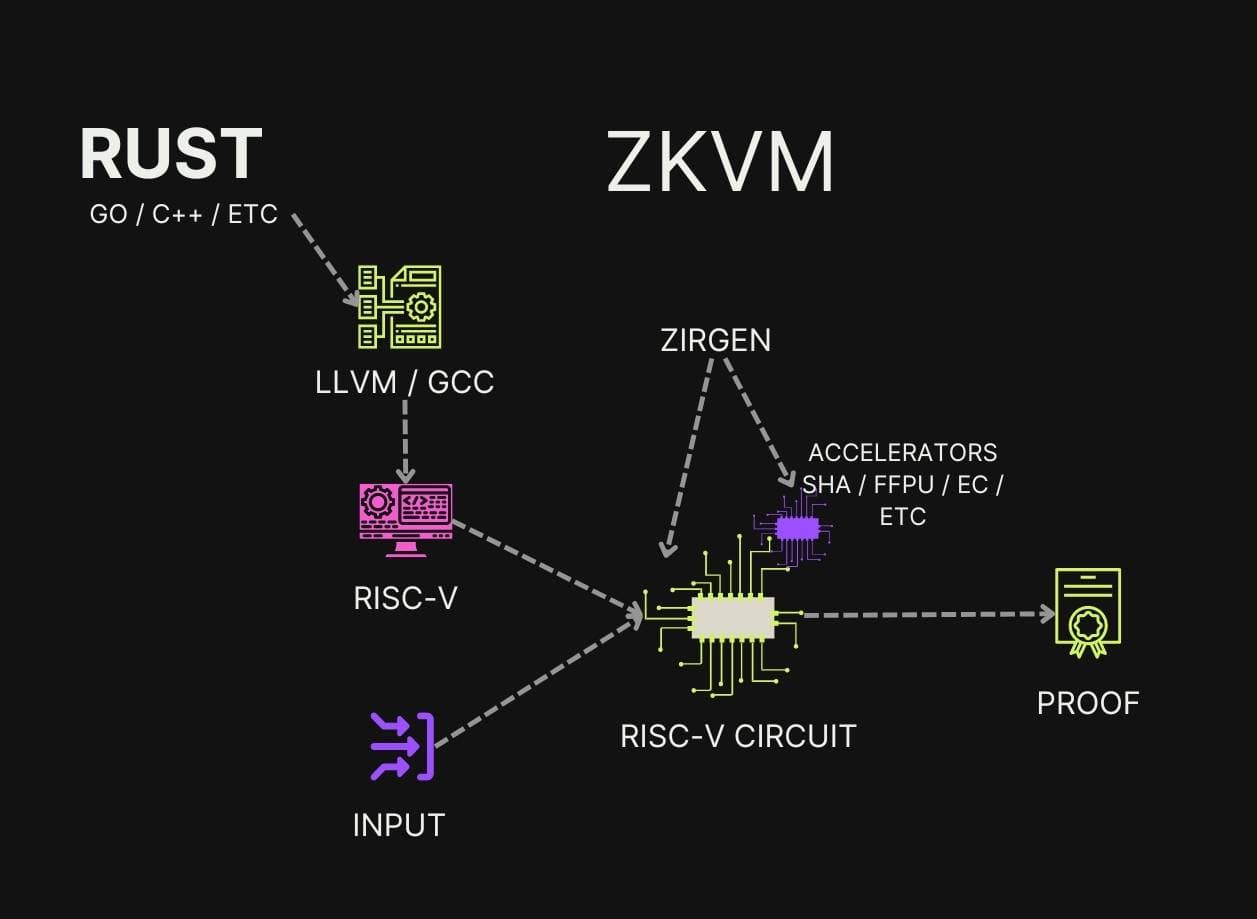
The RISC Zero pipeline transforms arbitrary computation into verifiable cryptographic evidence through a clean, four-stage process. A program - referred to as guest code - is written in Rust or C++, then compiled into a binary targeting the RISC-V instruction set. When executed, the entire computation is recorded as an execution trace. That trace is subsequently fed into a prover, which generates a zero-knowledge proof: a mathematical certificate confirming that the program ran correctly given a specific input. The output is a receipt - a compact, verifiable proof that any party (including an on-chain smart contract) can independently validate. Importantly, the blockchain never needs to understand what the program did. It only needs to confirm one thing: the result is correct.Bonsai: Cloud Infrastructure for ZK Proving
To make zero-knowledge proving accessible in production environments, RISC Zero offers Bonsai — a fully managed, cloud-based proving service. With Bonsai, developers simply call an API from a smart contract or backend service. The request is routed to RISC Zero's infrastructure, where computation is executed off-chain and a proof is generated. The result and its corresponding proof are then returned via a relay contract.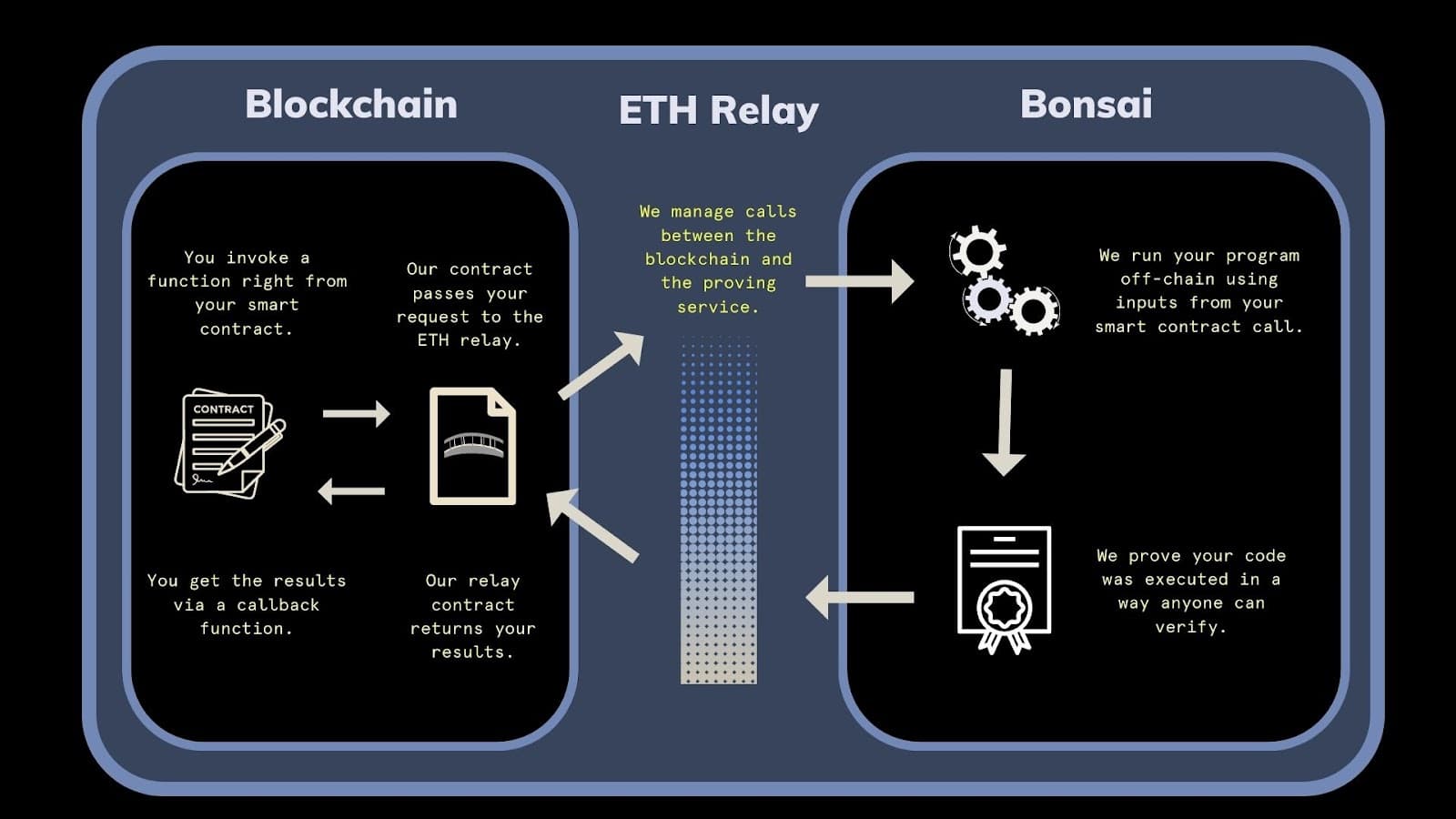
Bonsai delivers a developer experience comparable to traditional cloud services:
- Fast response times
- Stable uptime and reliability
- Simple API integration
Boundless: A Decentralized Proving Marketplace
If Bonsai represents the centralized path, Boundless represents its trustless counterpart. Boundless operates as an open marketplace where permissionless prover nodes compete to fulfill proof requests and earn rewards. When a request enters the system, nodes participate in an auction mechanism to execute the job and generate the corresponding proof. The architecture spans several components:- A Marketplace for job distribution
- A Broker layer for coordination
- Proving clusters for execution
- Independent prover nodes contributing to the network
- Lower stability compared to managed services
- Inconsistent latency
- Dependency on network participation and liveness
Centralized vs. Decentralized Proving: Two Valid Paths
Rather than committing to a single architecture, RISC Zero deliberately supports both models:- Bonsai suits production deployments, early-stage startups, and systems where uptime is non-negotiable
- Boundless suits Web3-native protocols where trustlessness and decentralization are first-order requirements
- Cloud (Web2-style) vs. Network (Web3-style)
- AWS vs. Ethereum
Use Cases: When Blockchain Starts to "Understand" AI
The ability to prove arbitrary computation unlocks a new design space for Web3 applications. Consequently, several high-impact use cases are already emerging:- ZK Privacy: Process sensitive user data while preserving on-chain verifiability - without exposing raw inputs
- ZK Coprocessor: Extend smart contract capabilities far beyond current on-chain computation limits
- AI & Complex Computation: Bring machine learning inference and advanced algorithms into blockchain workflows - without running them natively on-chain

This represents a meaningful architectural shift: from blockchain as a narrow financial execution layer, to blockchain as a trust layer for complex, real-world computation - including future applications in Real World Assets (RWA) verification, identity, and AI-driven on-chain agents.
Trade-Offs: There Is No Magic
Despite its capabilities, RISC Zero operates within the inherent constraints of zero-knowledge cryptography. These are not RISC Zero-specific limitations - they are fundamental characteristics of the entire ZK space:- Proving time: Generating a proof remains computationally intensive and time-consuming
- Cost: ZK proving carries meaningful infrastructure overhead
- Debugging complexity: Diagnosing issues in ZK circuits is significantly harder than traditional software development
Conclusion: Blockchain as a Truth Verification Layer
RISC Zero is more than a new technology. It represents a new mental model for what blockchain is and what it should do. By cleanly separating two distinct responsibilities:- Off-chain: execution of computation
- On-chain: verification of results
Author: Quy Anh Nguyen Viet, Security Research member of A-Star Group Compiled by Dieu Anh