
·Blog
Vietnam Launches Its National Layer 1 Blockchain
Bui Quang Phuc & Nguyen Cong Hieu
NDAChain is Vietnam' s national Layer 1 permissioned blockchain, functioning as a decentralized data verification infrastructure directly integrated with the National Database (NDB).
By combining Hybrid DID architecture, Zero-Knowledge Proofs (ZKPs), and a Proof of Authority (PoA) consensus mechanism, the platform delivers strict large-scale privacy while achieving transaction throughput of thousands of TPS.
More critically, its core strategic objective is to create a low-cost VND-denominated identity and payment tool, one designed to formalize and repatriate hundreds of billions of dollars in digital asset flows from foreign markets back into the domestic economy.
Vietnam's $100B Digital Infrastructure Challenge
Vietnam's digital transformation boom gave rise to the National Data Center (NDC). However, this centralized storage model quickly exposed three structural weaknesses: cybersecurity vulnerabilities, scalability bottlenecks, and the absence of global interoperability standards. Simultaneously, the country faced a severe macroeconomic dilemma: over $100 billion USD in annual digital asset transaction volume was flowing entirely through foreign platforms, creating a massive capital drain and threatening the nation's financial sovereignty. To address this dual infrastructure-and-capital-flow crisis, the Vietnamese government launched an aggressive regulatory framework during 2024-2026. New mandates required all trading platforms to obtain domestic licenses and integrate VND payment gateways. The inevitable outcome: NDAChain, launched in July 2025. Far more than a technology upgrade, NDAChain represents a sovereign trust infrastructure, resolving the tension between the State's demand for secure data sovereignty and the market's desire for a decentralized financial ecosystem. In doing so, it has the potential to reclaim capital flows and reshape the digital power structure of an entire nation.Core Analysis: NDAChain's Modular Blockchain Architecture
NDAChain is designed as a permissioned Layer 1 blockchain - a closed-network system with strictly controlled access - built on the open-source Hyperledger Besu - Ethereum client, specifically engineered for enterprise-grade requirements. Unlike public blockchains where anyone can participate anonymously, NDAChain creates a tightly controlled environment that merges the legal authority of national databases with the transparency and immutability of distributed ledger technology. Its architecture represents a sophisticated fusion of centralized governance and decentralized validation.Three-Layer Infrastructure Architecture
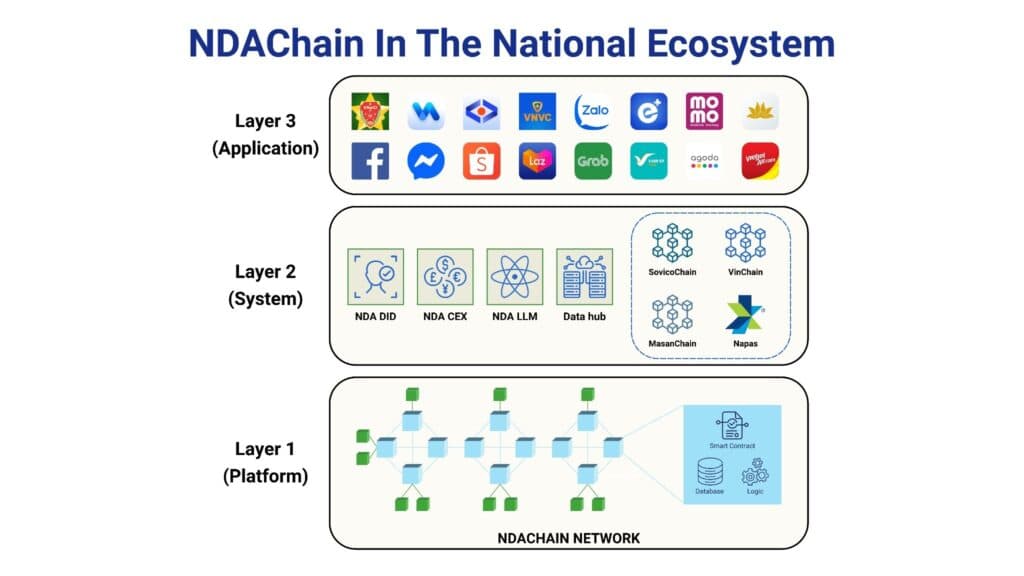
Rather than a monolithic blockchain, NDAChain employs a Three-Layer Infrastructure Architecture to optimize modularity, scalability, and risk isolation between application layers and core infrastructure stability: Layer 1 (Core Layer): The distributed ledger foundation where validator nodes execute consensus mechanisms and produce blocks. Integrated with Vietnam's Blockchain Service Network (VBSN), this layer supports multi-chain architecture, enabling rapid deployment of new Layer 1 chains in under one hour, complete with built-in RPC infrastructure and smart contract tooling. Layer 2 (Sector-Specific Layer): Serves as specialized middleware, centered on the NDA DID system (Vietnam's national decentralized identity and data verification system) and smart contracts managing secure data exchange between government and enterprise. This layer provides unified validation standards, abstracting blockchain complexity from end-user applications. Layer 3 (Application Layer): Contains user-facing interfaces such as NDATrace (product traceability) and NDAKey (digital identity wallet). These interact with Layer 2 through open APIs and SDKs published by the National Data Association, enabling private-sector integration into the ecosystem. Internally, the system operates on a closed, strictly secured data flow. The National Database (NDB) serves as the central repository with absolute legal authority over identity data, yet remains completely isolated from the outside world. All queries must pass through the API Gateway (APIG), a firewall and secure communication interface using TLS encryption and OAuth 2.0 authentication via JWT tokens. APIG ensures real-time data synchronization through event-driven architecture and message queues. In identity workflows, the Ministry of Public Security' s VNeID application serves as the initial touchpoint for citizen consent; only upon granting permission does data get processed and anchored on chain through DID Smart Contracts.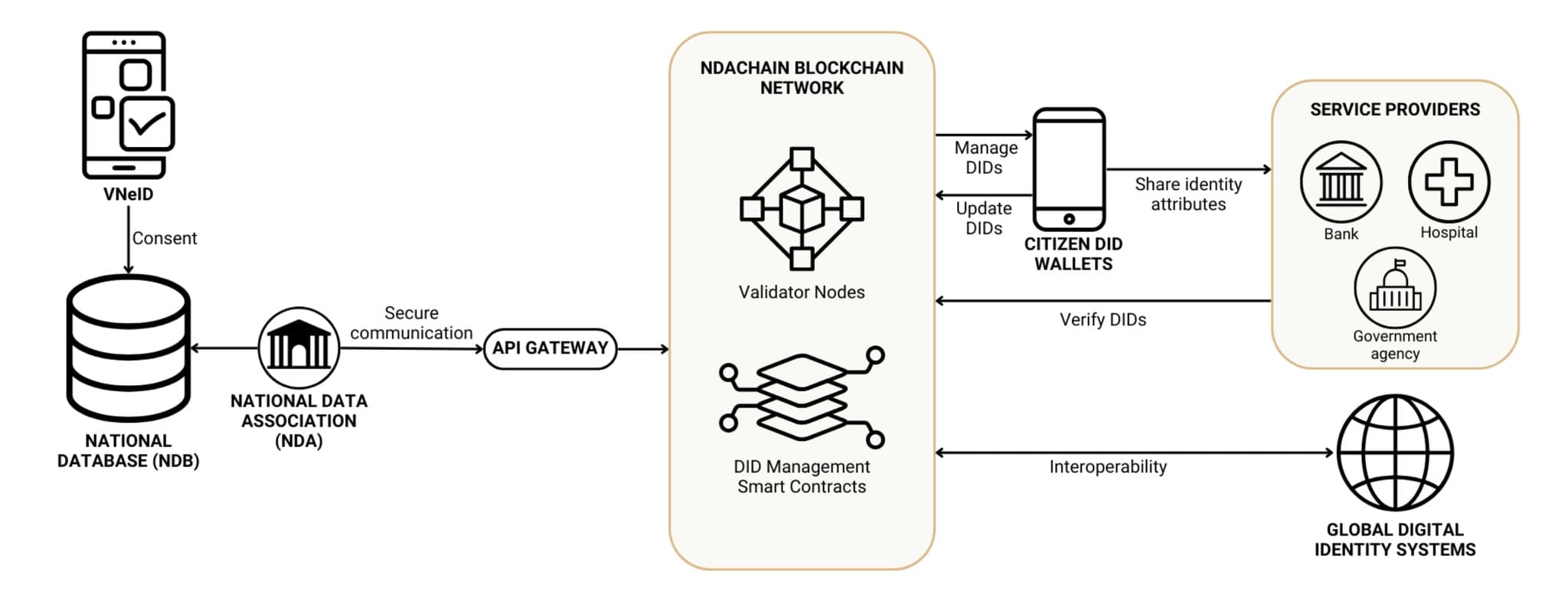
Hybrid DID: Decentralized Identity Meets State Authority
The heart of NDAChain is its Hybrid Decentralized Identity (Hybrid DID) model, reconciling the government's central identity authority with user data autonomy. Upon initialization, demographic data extracted from the NDB is never stored directly on-chain. Instead, a cryptographic hash combined with a public key generates a unique identifier string (e.g., did: nda:123456789abcdefghi), forming the DID Document and recorded on-chain via the smart contract's ‘registerDID’ function. The system' s core security strength lies in Verifiable Credentials (VCs). Trusted institutions (Issuers) issue VCs - structured JSON data packages containing attribute information, issuance date, and critically, a cryptographic proof from the issuing organization - representing sensitive information such as blood type, credit history, and academic qualifications. Citizens store VCs entirely off-chain in their NDAKey mobile wallet. When needed, service providers (Verifiers) simply cross-reference the signature on the user-presented VC against the Issuer' s public key on the blockchain. This mechanism enables instant data integrity verification without querying the original database, thereby minimizing latency and ensuring absolute privacy protection.Proof of Authority (PoA) Consensus Mechanism
NDAChain' s processing power does not rely on energy-intensive cryptographic computation like Bitcoin' s Proof of Work (PoW), nor on staked token collateral like Ethereum's Proof of Stake (PoS). Recognizing the need for legal identity control and extreme performance at national scale, NDAChain adopts the Proof of Authority (PoA) consensus algorithm. In PoA, block creation and transaction validation rights are not granted through computational power or capital, but through "reputation" and legal authorization. Only nodes owned by strictly vetted and licensed organizations may participate in consensus. NDAChain' s network currently operates through a consortium of 49 validator nodes. Block production proceeds in an orderly round-robin rotation. For each block height h, a specific validator is designated to propose a block using the formula: V_i = V_h (mod N) Where V_i is the selected validator, h is the block number, and N is the total number of validators. The selected validator Vi collects transactions from the mempool, verifies validity, and proposes block Bh. Subsequently, other consortium validators independently verify all digital signatures and transaction logic. If block Bh is valid, all nodes reach consensus and record it in their local blockchain. This model integrates Byzantine Fault Tolerance (BFT), ensuring network safety as long as faulty or malicious nodes do not exceed (N−1)/3, while governance smart contracts automatically slash or remove violating nodes. By eliminating redundant computation, PoA delivers exceptional performance: from 1,200 TPS with 1.5-second transaction confirmation in the Pilot phase, with theoretical throughput potential of 300,000 TPS when optimized on VBSN infrastructure - sufficient to support the entire national digital economy.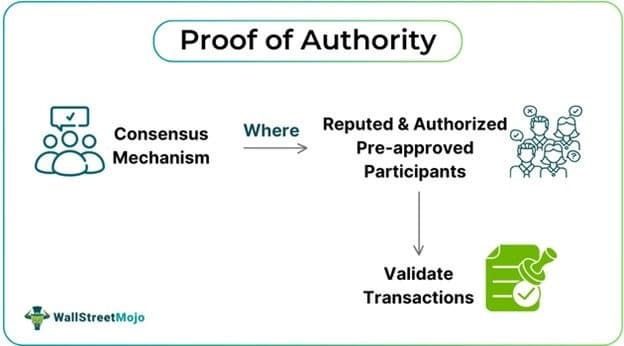
Zero-Knowledge Proofs (ZKPs) for Privacy-Preserving Security
While the DID mechanism anonymizes raw data, publicly disclosed transactions and on-chain public key linkages still present privacy risks if subjected to chain analysis. To comprehensively address this, NDAChain has deeply integrated Zero-Knowledge Proofs technology - specifically the zk-SNARKs protocol (Zero-Knowledge Succinct Non-Interactive Argument of Knowledge)-comprising three independent phases:- Setup Phase: The system performs a trusted setup, generating public parameters (pp) and a verification key (vk) through the generator function: G( 1 ^λ) → ( pp, vk) .
- Proving Phase: When a user (Prover) wishes to prove a statement ( x) is true without revealing the actual data ( witness w) , they run algorithm P( pp, x, w) on their local device to generate a concise cryptographic proof π.
- Verification Phase: The receiving party (Verifier) receives statement x and proof π, then runs algorithm V(vk, x, π) → {0,1} using the public verification key. A result of 1 confirms the statement; 0 rejects the proof.
- Completeness: If w is a valid witness for x, then V(vk, x, π) = 1. Honest users always pass verification.
- Soundness: If V(vk, x, π) = 1, a valid w must necessarily exist. An attacker cannot forge proofs.
- Zero-Knowledge: Proof π contains and reveals absolutely no information about the original data w.
NDATrace: National Product Traceability Protocol
Extending beyond human identity, NDAChain redefines physical asset management through NDATrace, the national product traceability platform providing digital identity for goods across the supply chain. NDATrace' s operating mechanism integrates seamlessly with global standards. Each product receives a Unique Identifier (UID) in the form of a dynamic QR code or RFID chip, designed in compliance with the GS1 Digital Link standard, connecting physical identity to the blockchain ledger. Manufacturing enterprises act as Issuers, using the NDATrace Portal to create product DIDs and issue Verifiable Credentials (VCs) recording each step in the product lifecycle from raw material origin and production processes to quality certification and logistics journeys. These VCs are anchored in NDAChain' s immutable ledger. As products circulate, consumers or customs authorities can scan the UID using an application. The app queries NDAChain to validate signatures on all related VCs. If any information has been tampered with in intermediary databases, the blockchain hash will not match, instantly detecting fraud. This system not only combats counterfeiting but also serves as a perfect "digital passport" for exported goods, meeting stringent origin transparency standards demanded by discerning markets such as the European Union.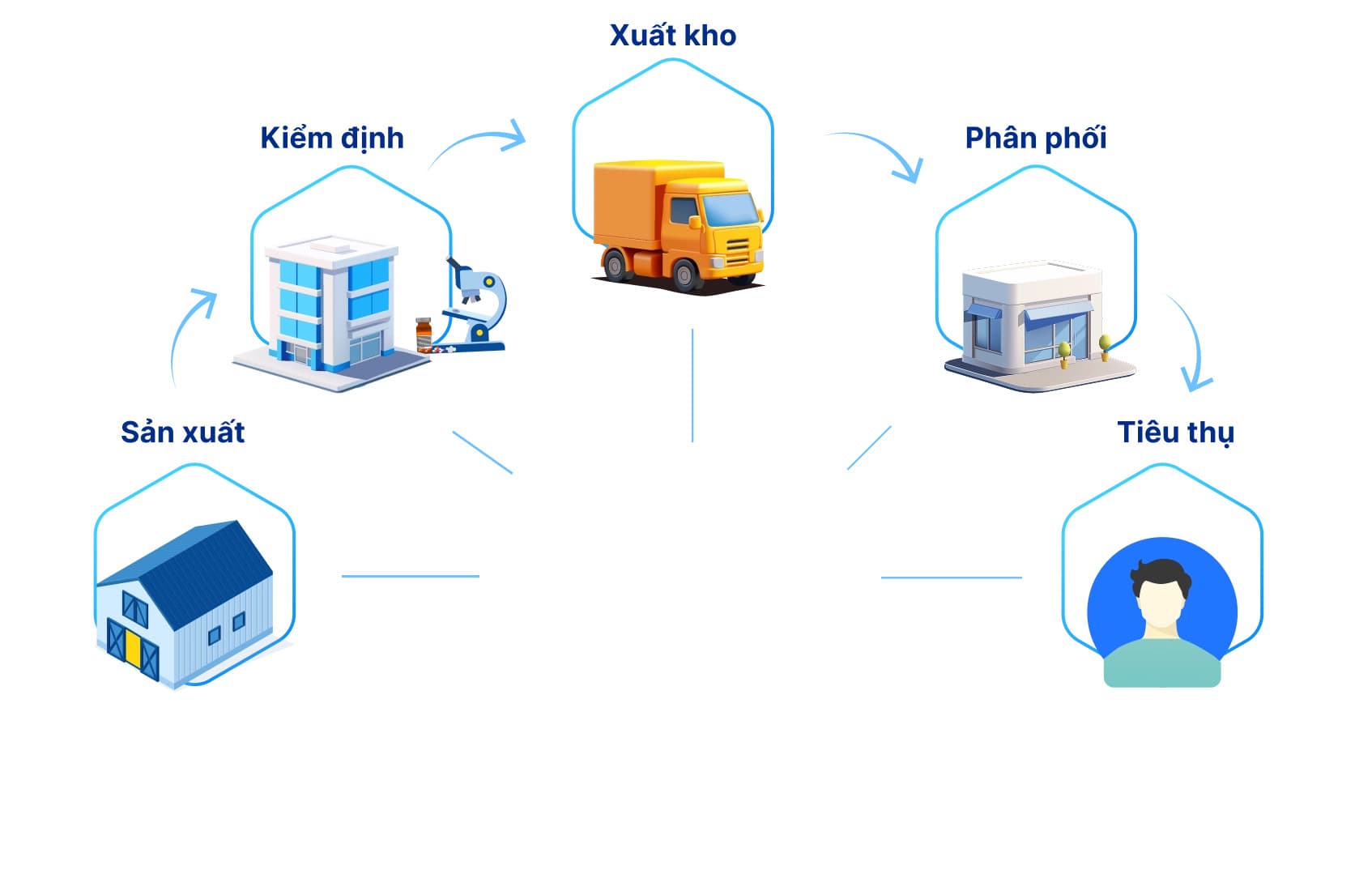
Technical Comparison: NDAChain vs. Leading Platforms
| Technical Feature | NDAChain (Pilot) | NDAChain (VBSN Target) | Ethereum (PoS) | Hyperledger Fabric |
| Consensus Mechanism | Proof of Authority (PoA) | Multi-chain Customizable | Proof of Stake (PoS) | PBFT / Raft |
| Throughput (TPS) | ~1,200 TPS | Up to 300,000 TPS | ~15–30 TPS | Up to 3,500 TPS |
| Latency (Finality) | 1.5 seconds | ~0.5 seconds | ~12 seconds | < 1 second |
| Network Access | Permissioned | Permissioned / Hybrid | Permissionless (Public) | Permissioned |
| Energy Consumption | Very Low | Very Low | Low | Very Low |
| Fault Tolerance (BFT) | (N−1)/3 faulty nodes | Depends on L1 algorithm | 1/3 of staked supply | 1/3 of nodes |
Structural Insights: Power, Economics & Capital Flows
Deep analysis of NDAChain' s technical architecture reveals critical structural insights regarding political power, economic models, systemic risk, and capital distribution within Vietnam' s digital economy. NDAChain is not merely a software infrastructure update, it is a soft power redistribution tool and the foundation of a new digital financial order.Governance Architecture & Power Distribution
The greatest challenge for any national blockchain infrastructure is resolving the Blockchain Trilemma between Decentralization, Scalability, and Security. Networks like Ethereum prioritize decentralization and security while sacrificing speed. For a critical national infrastructure system, NDAChain makes a deliberate trade-off: sacrificing absolute decentralization to maximize scalability, performance, and legal compliance, creating a hybrid governance model.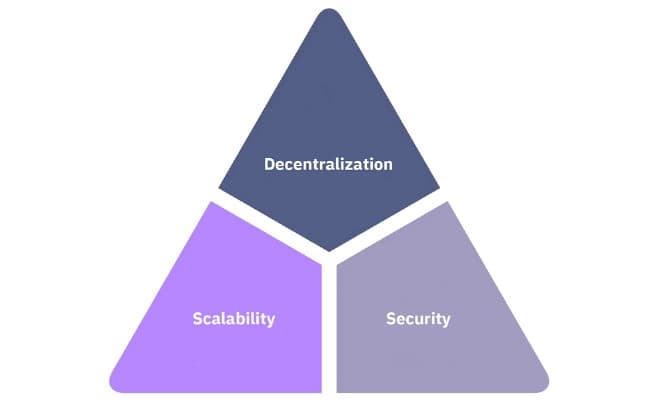
NDAChain' s power distribution is defined by its 49-node validator consortium. The unique characteristic of this consortium is the strategic blend of state authority, big tech, and major private conglomerates, operated by the National Data Center (NDC), Ministry of Information and Communications, major city governments, alongside industry leaders including Viettel, VNPT, Sun Group, Masan, Zalo, MISA, and Sovico. This design delivers superior systemic benefits: it distributes physical infrastructure risk, leverages advanced private cloud computing capabilities, and cleverly ties the commercial interests of major corporations to the government' s data ecosystem.
Furthermore, the NDC is technically designated as the Root Validator. Unlike a standard 1-node-1-vote mechanism, the NDC holds 35% voting power across the entire network - ensuring supreme state control. The 35% figure is a game-theory-based design. In a network requiring majority consensus to update protocols, pass multi-signature contracts, or manage validator onboarding, this 35% grants NDC absolute veto power over any critical system change. This makes NDAChain completely immune to 51% attacks or the risk of oligarchic capture - ensuring inviolable digital data sovereignty for the nation.
Comparatively, Vietnam' s structure is more flexible and innovation-friendly than China's fully state-controlled BSN, yet more centralized and law-enforceable than Europe' s loosely governed EBSI network.
Unit Economics & Incentive Structures
What motivates a major private enterprise to invest hundreds of thousands of USD in high-grade security hardware, pass stringent technical audits, and maintain an NDAChain node? On public blockchains, the incentive is always blocking rewards and transaction fees paid in speculative native tokens. However, NDAChain employs an entirely different incentive architecture that redefines the microeconomics of blockchain adoption. The first breakthrough is the elimination of gas fee volatility risk. NDAChain does not use volatile cryptocurrencies (like ETH or SOL) as gas fees - historically the biggest barrier preventing traditional enterprises from adopting Web3, since they cannot budget when gas prices fluctuate constantly. Instead, all NDAChain interactions - from issuing digital certificates and activating smart contracts to supply chain traceability - are calculated on a fixed service fee model, paid in the domestic currency (VND). This fee is tightly regulated by the Ministry of Finance, applying a mechanism similar to securities transaction fees (approximately 0.1% - 0.15% on digital asset transaction values, or a fixed fee per API call). This effectively transforms blockchain into an enterprise-ready Software-as-a-Service model. The second breakthrough is the reward through data access privileges. The real incentive for major organizations is priority access to the national Data Layer. By operating nodes and deeply integrating into the NDADID ecosystem, these organizations dramatically reduce KYC costs, minimize identity fraud risk, and can automate business processes - such as credit scoring and bank account opening - based on state-verified data. The motivation here is not token mining, but data advantages and operational efficiency in their core business.Capital Flows & Digital Asset Formalization
NDAChain's most important macro-structural role is reshaping capital flows worth hundreds of billions of dollars. The pre-2025 Vietnamese crypto market was a paradox: a country with 17 million investors participating in the digital asset market with annual transaction volumes exceeding $100 billion USD, yet the domestic banking and tax systems were entirely on the sidelines. Nearly 100% of this massive capital flow moved through underground P2P channels and was held on offshore exchanges like Binance and Bybit. NDAChain was not created solely to manage citizen identity; it is the state-prepared financial infrastructure to legalize and repatriate crypto capital flows into the domestic market. As Resolution No.05/2025/NQ-CP and new policies take effect, five pilot-licensed digital asset exchanges will be mandated to use the NDADID system for customer identity verification and NDAChain as the custody and transaction reconciliation layer.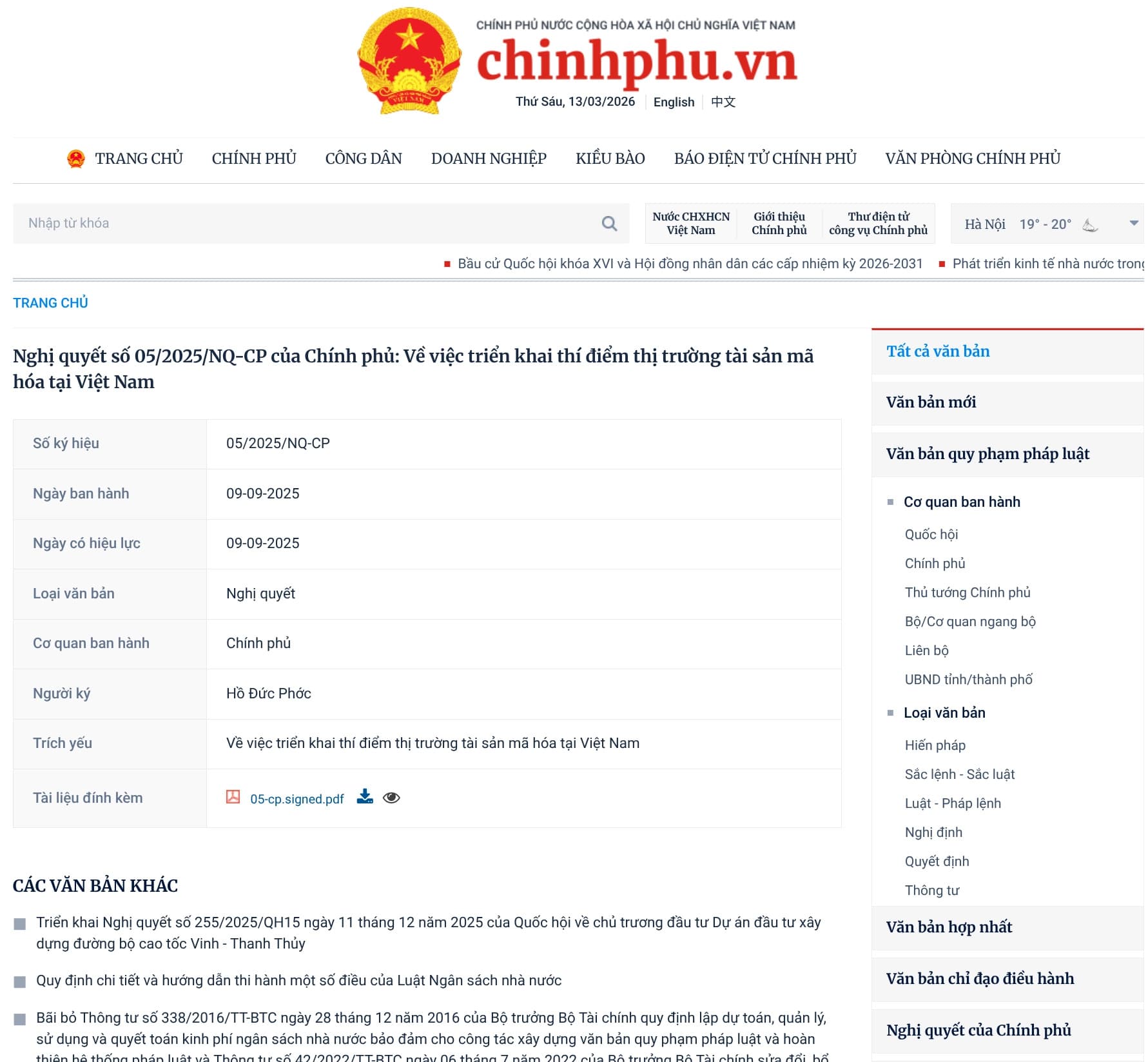
This structure delivers a dual benefit for the state: it enables the Ministry of Finance to track capital flows and collect digital asset transaction taxes, while simultaneously integrating the crypto market into the State Bank' s oversight system. Furthermore, NDAChain opens the door to Real World Asset (RWA) tokenization.
Traditionally illiquid assets - corporate bonds, investment fund units, commercial invoices - will be issued, fractionalized, and traded as tokenized securities on NDAChain. When VND-pegged stablecoins receive regulatory approval, NDAChain will transform into a derivative financial infrastructure capable of 24/7 settlement at ultra-low cost, reshaping the entire structure of Vietnam' s capital markets in the coming decade.
Implications: Who Is Affected and How
The emergence of a national core infrastructure like NDAChain - with its Hybrid DID mechanism, ZKPs, and limited-decentralization PoA system - creates seismic waves that will reshape the operational strategy of every stakeholder in the economy.For Builders (Developers)
Through open API/SDK toolkits, builders can easily integrate NDADID verification and Verifiable Credentials without building their own KYC systems or requiring users to pay crypto gas fees. Furthermore, the VBSN multi-chain architecture enables startups to flexibly deploy industry-specific compliant app-chains (healthcare, insurance) with dedicated governance.For Investors
NDAChain provides a secure legal corridor unlocking massive capital inflows from institutional funds. The emergence of Real-World Asset (RWA) tokenization and the "Crypto Bank" model create 24/7 liquidity, opening access to premium assets and disruptive revenue growth opportunities for the banking sector.For Traders
Mandatory KYC through NDAKey ends the era of harmful anonymity, completely filtering out fraud and market manipulation. Traders gain legal protection and can transact directly through VND on/off-ramps at extremely low fees, while personal asset volumes remain absolutely protected by ZKP technology.For Auditors (Regulatory Bodies)
The immutability of the ledger ushers in the era of real-time auditing. Anti-Money Laundering (AML) and Counter-Terrorism Financing (CFT) processes are fully automated through smart contracts, automatically flagging and reporting anomalous transactions to regulatory authorities.For the Ecosystem
NDATrace becomes the "digital passport" enabling Vietnamese goods (such as agricultural products and textiles) to demonstrate transparent origin, easily clearing stringent non-tariff barriers in global trade. W3C, GS1, and GDPR compliance means these digital credentials are recognized by international customs systems (such as the EU), positioning Vietnam for deep integration into global supply chains.Watchlist: 5 Critical Milestones for 2026 - 2027
Although the whitepaper and initial deployment strategies outline an ambitious technology and financial roadmap, NDAChain ecosystem' s real-world success depends on execution capacity during 2026–2027. Analysts, institutional investors, and technology observers should closely monitor the following milestones to validate the investment thesis:- Validator Network Expansion: Plans to onboard additional organizations (NGOs, universities, local governments) into the current 49-node consortium—assessing actual decentralization levels.
- Exchange Licensing Execution: Monitoring implementation of Resolution No. 05/2025/NQ-CP (effective 01/01/2026) to observe liquidity migration from international to domestic exchanges.
- Legal Stablecoin Pilots: Progress on researching VND-pegged stablecoins or piloting local USDT integration to complete Delivery vs. Payment (DVP) settlement mechanisms and unlock Real World Asset (RWA) transactions.
- QuantumResistant Cryptography Upgrade: The transition pathway from zk-SNARKs to zk-STARKs to ensure long-term security resilience against advances in quantum computing.
- Tax Revenue Effectiveness: The Ministry of Finance' s first report on digital asset tax revenue (projected at 0.1%–0.15%) to quantify NDAChain' s capacity to formalize the shadow economy.
Closing Notes: A New Benchmark for Sovereign Digital Infrastructure
NDAChain' s emergence marks a pivotal strategic inflection point for Vietnam—transforming the nation' s role from a pure technology consumer to an infrastructure provider and master of its own core digital stack. The sophisticated fusion of legally centralized storage authority (NDB), high-security decentralized identity via Zero-Knowledge Proofs, and limited-decentralization multi-stakeholder governance (Consortium PoA) has produced a delicate and rare global equilibrium: one that simultaneously ensures absolute state data sovereignty while cultivating fertile ground for private-sector innovation. If Vietnam successfully executes the digital asset integration and legalization roadmap by 2026, NDAChain will not only succeed in "pulling" tens of billions of USD in capital back onshore, but it will also establish a new global benchmark for trust infrastructure, elevating Vietnam' s comprehensive competitiveness in the digital economy on the world' s technology and financial map.References
- NDAChain Whitepaper
- Nghị quyết số 05/2025/NQ-CP của Chính phủ: Về việc triển khai thí điểm thị trường tài sản mã hóa tại Việt Nam
- Diễn đàn 'Công nghệ định danh và truy xuất nguồn gốc – Nâng tầm hàng Việt'
- NDAChain
- NDATrace
- NDAKey
Author: Bui Quang Phuc & Nguyen Cong Hieu, Security Researcher of A-Star Group
Compiled by Dieu Anh